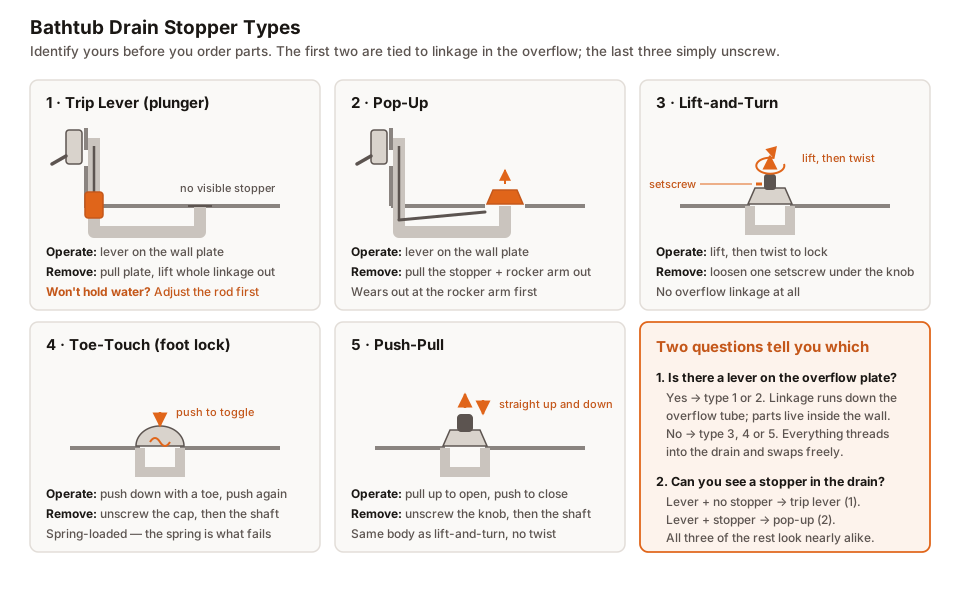
Before you order a single part, you need to know which of the five you have. Ordering the right stopper for the wrong drain type is the most common way a ten-minute job becomes a Saturday.
Short version if you’re in a hurry: no lever on the wall plate means you can drop in any replacement tub stopper that threads into the crossbar, and you’ll be done this afternoon. A lever on the plate means the mechanism lives inside the wall and the fix is usually an adjustment rather than a purchase. The two questions below tell you which you’ve got.
The Two Questions That Settle It
One: is there a lever on the overflow plate? That is the round or oval cover on the tub wall a few inches below the rim.
If yes, you have linkage running down inside the overflow tube. That is a trip lever or a pop-up.
If no — plain plate, maybe a couple of screws — everything you have threads into the drain in the floor of the tub, and the overflow is doing nothing but overflowing.
Two: can you see a stopper sitting in the drain?
Lever, no visible stopper → trip lever. Lever, visible stopper → pop-up. No lever → lift-and-turn, toe-touch, or push-pull, and you tell those apart by how they operate.
That is the entire identification. Everything below is detail.
Trip Lever (Plunger)
The lever on the plate is connected to a brass or plastic plunger hanging inside the overflow tube. Flip the lever down and the plunger drops into the tee below, blocking the passage. There is nothing in the drain opening at all — just a strainer.
Common in homes built before the 1990s and still sold today.
How it fails. It stops holding water. Almost always this is the linkage drifting out of adjustment, not a worn part. The rod between the lever and the plunger has a threaded section in the middle; lengthening it a few turns drops the plunger further and restores the seal.
How it comes out. Two screws on the plate, then lift the entire lever-rod-plunger assembly straight up and out through the overflow opening. It comes out as one piece, and it is longer than most people expect.
Pop-Up
Same lever on the same plate, but instead of a plunger there is a rocker arm running horizontally under the tub floor to a visible stopper sitting in the drain. Flip the lever and the arm rocks the stopper up or down.
How it fails. At the rocker arm. It is a thin piece of metal doing repeated bending, and it wears at the pivot. When a pop-up starts sitting crooked or refusing to lift, that is usually it.
How it comes out. Lift the stopper and pull. The rocker arm comes with it, snaking out of the drain — a slightly alarming amount of metal for a small opening, but it is meant to do that.
Lift-and-Turn
A stopper sitting in the drain with a small knob on top. Lift it slightly and rotate to lock it open or closed.
Nothing in the overflow at all. The stopper threads onto a shaft that screws into the drain crossbar.
How it comes out. Open the stopper, look at the underside of the knob for a small setscrew, back it off with an Allen key, and lift. On some, the knob unscrews counterclockwise instead. If it will not budge either way, hold the stopper body still and turn the whole assembly counterclockwise — it is threaded into the crossbar.
How it fails. The setscrew loosens and the stopper spins uselessly, or the seal underneath hardens and stops sealing.
Toe-Touch (Foot Lock)
Push it down with your toe and it locks closed. Push again and it springs open. No knob, no lever, no linkage.
How it fails. The internal spring. When a toe-touch stops staying down or stops popping up, the spring cartridge is done and the usual fix is a new stopper rather than a repair.
How it comes out. Unscrew the cap — usually the whole top comes off counterclockwise, sometimes with a screw underneath — then unscrew the shaft from the crossbar.
Push-Pull
Looks nearly identical to lift-and-turn, but you pull it straight up to open and push straight down to close, with no rotation. Same body, same threading, different action.
How it fails and comes out. Same as lift-and-turn: the knob unscrews, then the shaft.
What You Can Swap For What
This is the practical payoff of identifying yours.
The last three are interchangeable. Lift-and-turn, toe-touch and push-pull all thread into the same drain body or its crossbar. Swapping between them is a ten-minute job with no wall access and no plumbing.
The first two are not, quite. Trip lever and pop-up share the overflow linkage but use completely different lower hardware, so converting one to the other means changing both the linkage and the drain fitting.
Going from a linkage type to a threaded type is the conversion people usually want — it removes the parts that live inside the wall. It works, but you have to pull the linkage out of the overflow tube and cap the plate, and the existing drain body has to have a crossbar for the new stopper to thread into. Some older drains do not.
Going the other way — threaded to trip lever — is rarely worth it.
If you’re converting away from a trip lever, you’ll need the full waste and overflow kit rather than a stopper on its own — the linkage and the lower fitting change together, and buying just the visible part leaves you with half a job and an open wall.
Measuring Before You Order
The drain body is 1½ inch and that part is genuinely standard. The stopper hardware is not.
Before ordering, get two measurements:
Thread size on the shaft. Most are 3/8-16 or 1/4-20 in the US. Take the old stopper to the store rather than guessing — it is the single reliable method.
Drain opening diameter. Measure across the opening in the tub, not the strainer. Most fall between 1½ and 1⅞ inches.
Universal stoppers exist and mostly work, but “universal” here means “comes with three adapters,” not “fits everything.” Bring the old part.
When It Is the Drain, Not the Stopper
Sometimes the stopper is fine and the drain body underneath is the problem.
Water seeps out slowly with the stopper closed and no adjustment helps — the seat inside the drain body may be pitted or corroded, and no stopper will seal against it.
The crossbar is broken. Common on old drains, and it means threaded stoppers have nothing to grip. This usually shows up when someone has previously attacked a stuck drain with pliers.
Rust around the opening. A cosmetic problem that becomes a sealing problem. There is a proper fix for this — see repairing rust around a bathtub drain.
In all three cases the drain body has to come out, which needs a dumbbell wrench rather than pliers. That job is covered separately in how to remove a stuck or broken bathtub drain.
Bottom Line
Two questions and you have your answer: is there a lever on the overflow plate, and is there a stopper visible in the drain.
If you have a lever and the tub will not hold water, adjust the rod before you spend a cent. If you have no lever, you can swap to any of the other threaded types this afternoon. And whatever you have, take the old part to the store rather than trusting the word “universal” on a package.
Keep Reading
- Bathtub Drain Diagram: Every Part, Labeled and Explained — how the stopper connects to everything behind the wall
- Tub Drain Assembly Parts Explained — every piece of a waste-and-overflow kit, numbered
- Bathtub Overflow Drain — How It Works — what the linkage types run through
- How to Remove a Stuck or Broken Bathtub Drain — when the drain body itself has to come out
- Best Bathtub Drain Hair Catcher for Dog Hair — for the problem the stopper does not solve
Common Questions
How do I know what type of bathtub drain I have?
Two questions settle it. Is there a lever on the overflow plate up on the tub wall? If yes, you have a trip lever or a pop-up, and there is linkage running down inside the overflow tube. If no, you have a lift-and-turn, toe-touch or push-pull, and the whole stopper threads into the drain itself. Then look in the drain: a lever with no visible stopper is a trip lever, a lever with a visible stopper is a pop-up.
Can I change my bathtub drain from one type to another?
Between lift-and-turn, toe-touch and push-pull, yes — freely. They all thread into the same drain body or its crossbar and take about ten minutes to swap. Changing away from a trip lever or pop-up means removing the linkage from the overflow tube, which is a bigger job but still doable without opening a wall.
Why won't my bathtub hold water?
On a trip lever or pop-up it is almost always linkage out of adjustment, not a worn part. The rod that runs down the overflow tube has a threaded adjustment; lengthening it drops the plunger further and seals better. On the threaded types it is usually a hardened seal or a stopper that has worked loose from its shaft.
How do I remove a lift-and-turn stopper?
Open it, look under the knob for a small setscrew, loosen it with an Allen key, and lift the stopper out. On some the knob itself unscrews counterclockwise instead. If neither works, the shaft is threaded into the crossbar and the whole thing unscrews.
Which bathtub drain type is best?
For reliability, toe-touch and lift-and-turn — nothing inside the wall to fail. For an old home with an existing overflow plate, trip lever, because it is what is already there and it is adjustable rather than replaceable. Pop-ups wear out at the rocker arm faster than the others.
Are bathtub drains a standard size?
The drain body is 1½ inch, which is standard for tubs across the US. The stopper hardware that threads into it is much less standardized between brands, which is why a stopper that looks identical to yours may not thread in.