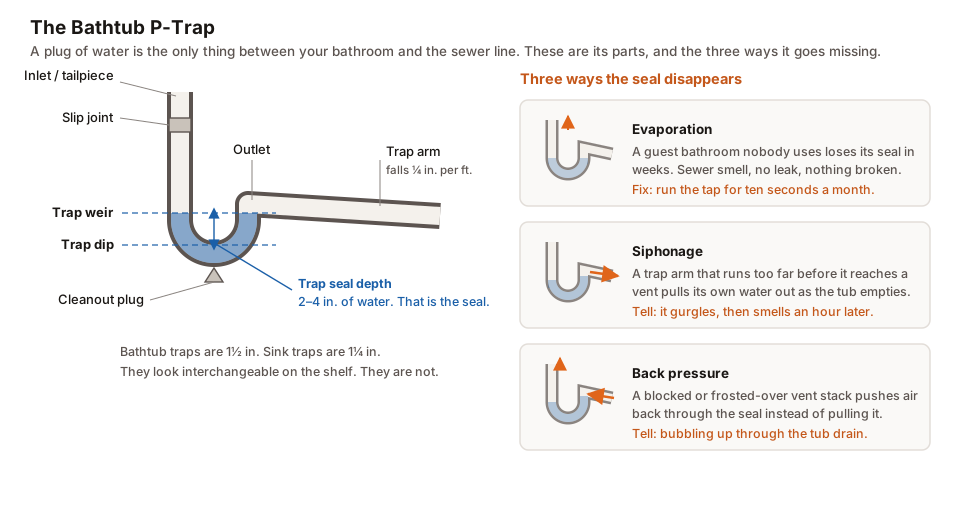
If your bathroom smells and there is no leak, no damp patch and nothing visibly wrong, the answer is almost always the trap — and specifically, the two to four inches of standing water inside it that is no longer there.
Worth knowing before you read further: in most cases nothing needs buying. A dry trap is a venting or evaporation problem, not a broken part. It’s only when the trap itself is cracked or corroded through that you need a 1½-inch P-trap kit — and that’s a ten-dollar part, not a plumber’s visit.
This is what that trap looks like, and what each part of it is called.
What the Trap Is Actually Doing
A P-trap is a piece of pipe bent so that it holds water when nothing is flowing.
That is the entire mechanism. Water sits in the low part of the bend. Sewer gas coming up the line hits that plug of water and stops. When you drain the tub, the flow pushes through and out, and gravity refills the bend behind it.
It is a device with no moving parts, no seals to wear out and no maintenance requirement, and it does the single most important job in your plumbing system. The failures are never mechanical. They are all about the water leaving when it should not.
The Parts, By Name
The names matter as soon as you start reading code or ordering fittings, and they are not intuitive.
Inlet / tailpiece. The vertical pipe dropping from the tub’s drain assembly into the trap.
Trap dip. The lowest point of the upper interior surface of the bend. It sets the bottom of the water column.
Trap weir. The high point of the lower interior surface on the outlet side — the level water has to reach before it spills out toward the drain line.
Trap seal depth. The vertical distance between the dip and the weir. That is the actual measurement of the water plug.
Outlet. The rising leg on the far side of the bend.
Trap arm. The horizontal run from the outlet to the vented branch drain.
Cleanout. On some traps, a threaded plug at the bottom of the bend so you can drain or clear it without pulling the joints apart. Old metal traps often have one; modern plastic ones usually do not.
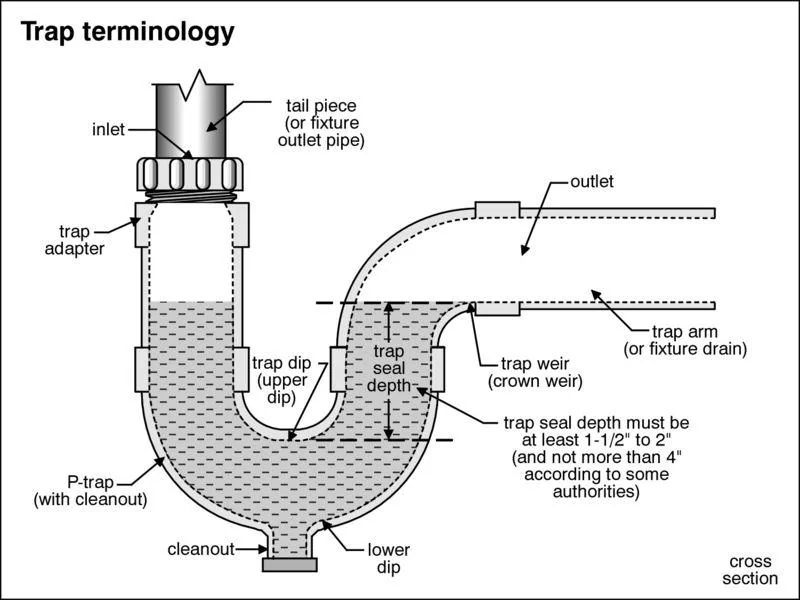
The same terminology on a conventional drawing. Worth committing to memory before you call a supply house.
Seal Depth, and Why Two to Four Inches
Codes generally require a trap seal of two to four inches. Both ends of that range are there for a reason.
Too shallow and there is not enough water to survive normal life. It evaporates in a room that goes unused. It gets pulled out by a partial siphon that a deeper seal would have shrugged off. Every disturbance costs you a larger fraction of the total.
Too deep and the trap stops scouring itself. Part of what keeps a trap clean is that a full tub draining moves fast enough to sweep the bend out. Make the bend deep enough and the water at the bottom stops participating, and solids settle there instead of leaving.
Deep-seal traps exist and have their uses — mainly in fixtures that go long periods without use — but the standard range exists because it balances those two failures.
The Three Ways a Trap Goes Dry
Everything that goes wrong with a trap comes down to the water leaving. There are exactly three mechanisms, and they are distinguishable by symptom.
Evaporation
A guest bathroom nobody uses will lose its seal in a matter of weeks, faster in dry winter air with the heat running. Nothing is broken. The water simply left.
The tell: the smell builds slowly, and running the tap for ten seconds fixes it completely for another few weeks.
The fix: use the fixture, or pour a cup of water down it monthly. A splash of mineral oil on top slows evaporation considerably in a bathroom that is genuinely never used.
Siphonage
When the tub drains, the column of water moving down the line creates suction behind it. Normally the vent lets air in to break that suction. If the trap arm runs too far before it reaches a vent, or the vent is undersized or missing, the suction pulls the trap’s own water out along with everything else.
The tell: it gurgles as it drains, and the smell is back the same day. This is the one that keeps coming back no matter how many times you run the water.
The fix: venting. Either the trap arm is too long, the vent is blocked, or there is no vent — none of which is a parts-store problem. On a remodel where a tub was moved, this is the usual explanation.
Back Pressure
The opposite failure. A blocked vent stack — leaves, a nest, or an ice cap in a cold climate — means air pushed ahead of water somewhere upstream has nowhere to go, so it comes back through the nearest trap.
The tell: bubbling up through the tub drain, sometimes with a visible burp of water.
The fix: clear the vent stack at the roof.
Trap Arms and Vents
The trap arm is where most of the real problems live, and it is the part people change without realizing they have changed anything.
Two rules govern it:
Fall. A quarter inch per foot, toward the drain. Less and it does not clear; more and the water outruns the solids and leaves them behind.
Length. There is a maximum developed length from the trap weir to the vent, and it depends on pipe size. For 1½ inch pipe it is short — short enough that moving a tub even a few feet during a remodel can put you past it. Past that limit, the trap siphons.
The vent also has to connect above the weir of the trap it serves. A vent takeoff below that level is not a vent, it is a second drain, and it does nothing to break the siphon.
Replacing a Trap
This is a genuinely easy job, which is why it is worth knowing the two ways people get it wrong.
The washer. Slip joints seal on a tapered nylon washer, and the taper points into the fitting, toward the pipe it seals against. Backwards is the single most common cause of a joint that will not stop weeping no matter how hard it is tightened.
The tightening. Hand tight, then a quarter turn with pliers. That is all. Slip joints are not compression fittings and cranking them down deforms the washer past the point where it seals. No tape, no pipe dope, no plumber’s putty — none of those belong on a slip joint.
Materials: PVC is fine and is what most plumbers use now. Brass looks better if the trap is visible under a clawfoot tub, and it lasts longer than the chrome-plated thin-wall traps sold at big-box stores, which corrode through at the bottom of the bend within a decade.
Buy a bag of assorted slip joint washers rather than the single one you think you need. Under a tub, on your side, in bad light, having the right taper already in your hand is worth far more than the two dollars it costs — and a hardened washer is the most likely thing you’ll find when you get the joint apart.
What About S-Traps?
If you pull an access panel on an old house and find a trap whose outlet drops straight down instead of running horizontally, that is an S-trap, and it is prohibited under modern code.
The reason is simple: with the outlet falling vertically, a full tub draining creates an unbroken column of water below the trap, and that column siphons the seal out behind it every single time. An S-trap does not sometimes fail. It fails on every use.
It is grandfathered in plenty of old houses and it explains a lot of persistent bathroom smells. Converting one to a proper P-trap means adding a vent, which is real work, but it is the actual fix.
Bottom Line
The trap is two to four inches of water in a bend, and it does the most important job in the house. It never fails mechanically — it fails by losing that water, and there are only three ways that happens.
Slow-returning smell is evaporation and costs nothing to fix. Same-day smell with a gurgle is venting and is real plumbing work. Bubbling up through the drain is a blocked stack on the roof. Knowing which one you have before you start pulling things apart saves the whole afternoon.
Keep Reading
- Bathtub Drain Diagram: Every Part, Labeled and Explained — the full assembly the trap hangs off
- Shower Drain Plumbing Diagram — same trap, different assembly above it
- Bathtub Overflow Drain — How It Works — the other path into the same tee
- Bath Waste and Trap Fittings — slip joints, solvent welds and why sealant on the wrong one causes the leak
- How to Remove a Stuck or Broken Bathtub Drain — when the strainer above it will not budge
Common Questions
What is trap seal depth?
The vertical distance between the trap dip and the trap weir — in plain terms, how deep the plug of standing water in the bend actually is. Codes generally require between two and four inches. Shallower than that and it evaporates or siphons away too easily; much deeper and the trap stops scouring itself clean.
Why does my bathroom smell like sewer with no leak anywhere?
The trap has lost its water seal. That is the only thing between the room and the sewer line, and when it goes, gas comes up through a drain that otherwise looks and behaves completely normally. There is nothing to find because nothing is broken.
Does a bathtub have to have a P-trap?
Yes. Every fixture connected to a drainage system needs a trap, and a bathtub is no exception. It is a code requirement everywhere in the US, and it is not the kind of thing to skip on a remodel to save an inch of height.
What size P-trap does a bathtub use?
One and a half inch. Sinks use 1¼ inch. They sit next to each other on the shelf and look almost identical, and a 1¼ inch trap will not fit a tub drain.
Can I use an S-trap on a bathtub?
No. S-traps are prohibited by modern code precisely because they siphon themselves dry — the outlet drops straight down, which lets a full column of draining water pull the seal out behind it. If you find one under an old tub, it explains the smell.
Why does my tub gurgle when it drains?
Air cannot get into the drain line fast enough to replace the water leaving it, so it pulls air through the trap instead. That is a venting problem, and the gurgle is the sound of your trap seal being partly siphoned out.
How long before an unused trap dries out?
In a heated house in winter, a few weeks. In a humid climate with the fixture in a closed room, a couple of months.