Most bathtub drain problems fall into a handful of categories, and most of them are DIY-fixable once you understand how the system actually works.
This guide covers the key parts of a standard bathtub drain assembly, what goes wrong with each, and how to fix the common problems. For a deeper breakdown of every component — including the physics of the P-trap and how the trip lever mechanism works — see the complete bathtub drain plumbing diagram guide.
The Key Parts of a Bathtub Drain System
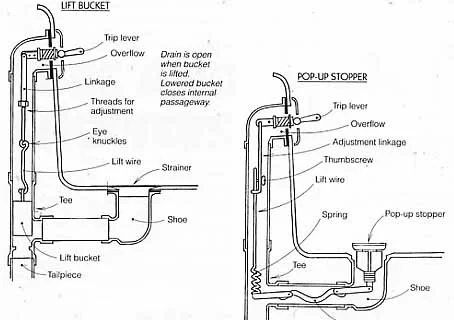
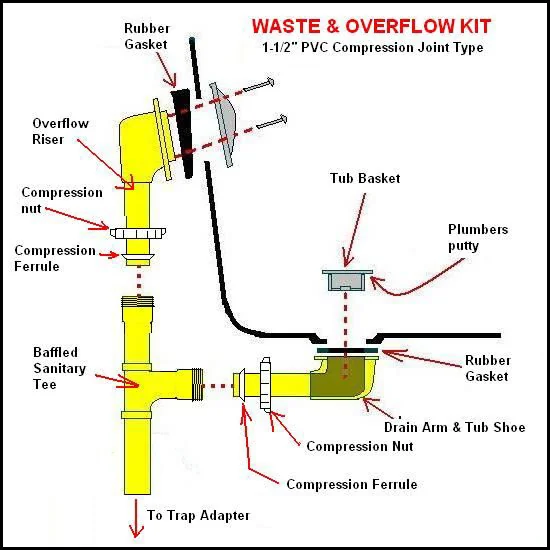
Drain Shoe
The drain shoe is the horizontal pipe fitting that connects the visible drain in the tub bottom to the vertical p-trap below. It’s usually 1.5 inches in diameter, made of brass or PVC, and threaded to accept the drain flange (the visible drain you see in the tub).
The drain shoe is set in the floor of the tub during installation, usually bedded in plumber’s putty. You’ll rarely see or interact with it unless you’re doing a full tub replacement.
Drain Flange (The Drain)
The threaded fitting you see in the bottom of the tub. The cross members in the center allow you to use a drain wrench or channel-lock pliers to thread it in and out of the drain shoe.
Common problem: Cross members corrode or break off over time, making the drain impossible to remove with standard tools. See how to remove a stuck or broken bathtub drain.
Overflow Plate
The decorative plate mounted on the tub wall a few inches below the top rim — usually with a lever or knob. Behind this plate is the bucket gate mechanism and the overflow tube that runs from the plate down to connect with the drain shoe.
The overflow is a safety feature: if you fill the tub too high, water flows into the overflow opening and drains rather than overflowing onto the floor.
Trip Lever
The lever or knob on the overflow plate that operates the stopper mechanism. There are several types:
Trip lever style (most common): The lever connects via a metal rod to a bucket gate inside the overflow tube. Moving the lever up/down raises/lowers the bucket gate, which blocks or opens the drain.
Lift-and-turn style: No lever — you manually lift and twist the drain flange to open/close it.
Push-pull style: You push the drain down to seal it, push it again to pop it open.
Bucket Gate
The stopper mechanism inside the overflow tube. On trip lever assemblies, this is a small brass or zinc bucket shape that drops down into the drain shoe opening to block water flow.
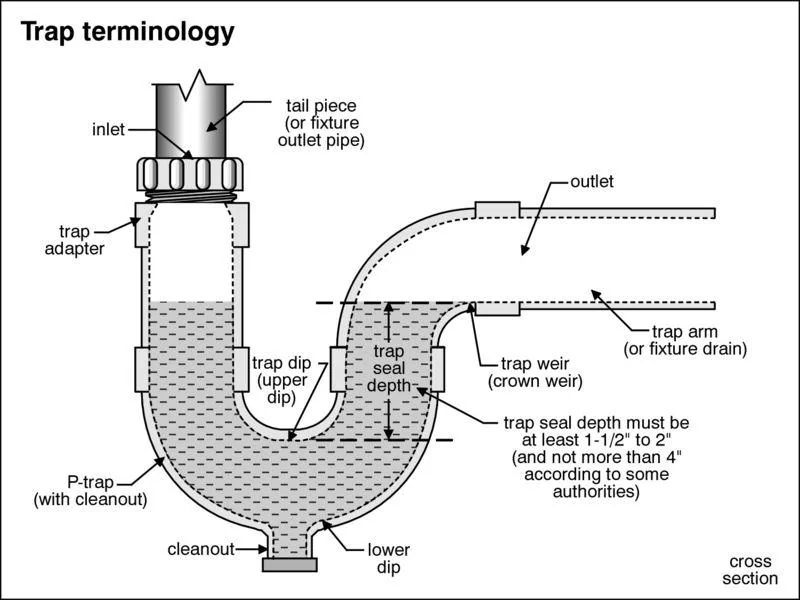
P-Trap
The curved pipe below the drain shoe that holds water — the water creates a seal that prevents sewer gas from coming up through the drain. P-traps are standard in all drain systems.
Common Problems and Fixes
Drain Won’t Hold Water
Most likely cause: The bucket gate isn’t seating properly.
On a trip lever system, the issue is usually the trip lever rod — the connecting rod between the lever and the bucket gate — has become too short or too long over time as the threaded connections loosen.
Fix:
- Remove the overflow plate (two screws)
- Pull the trip lever and rod straight up out of the overflow tube — the bucket gate should come with it
- Look at the adjustment nut on the rod: the bucket gate position is adjustable by turning this nut to lengthen or shorten the rod
- Adjust the rod so the bucket gate drops lower into the drain shoe when the lever is in the closed position
- Reinstall, test
If the rod is corroded or the mechanism is worn out, a replacement trip lever assembly is inexpensive and easy to swap — the whole thing lifts out through the overflow opening in one piece.
Lever Won’t Move (Frozen Trip Lever)
Most likely cause: The bucket gate has corroded in place in the overflow tube, or the pivot mechanism on the lever itself has corroded.
Fix:
- Remove the overflow plate
- Try spraying penetrating oil (PB Blaster or WD-40 Specialist Penetrant) down the overflow tube and onto the lever mechanism
- Wait 20–30 minutes and try again
- If it still won’t move, the bucket gate assembly may be corroded into the tube — apply more penetrating oil and try rocking it gently as you pull
If the lever moves but the gate won’t come out, it may be that the overflow tube has internal corrosion holding the gate. In this case, replace the whole assembly. Sometimes you can free it; sometimes you need to cut it out from below.
Slow Drain
Most likely cause: Hair and soap buildup in the p-trap.
Fix:
- First try: a drain hair catcher going forward, and a drain snake to clear existing buildup
- Do NOT use chemical drain cleaners on a refinished tub — they damage the coating
- A hand snake inserted into the drain and worked down into the p-trap will usually break up and pull out the clog
Drain Won’t Unscrew (Cross Members Broken)
If the cross members in the drain flange are corroded or broken off, you can’t grip them with pliers or a standard drain key. You need a friction drain removal tool.
This tool inserts into the drain opening and expands outward against the walls of the drain. Turn the center with a socket wrench to expand the tabs, then reverse-turn to unscrew the drain. It works even on completely stripped drains.
For the full guide on stuck drains, see how to remove a stuck or broken bathtub drain.
Water Around the Drain Flange (Tub Leaking from Bottom)
If water is showing up under the tub near the drain — visible from below if you have a crawlspace or access from below — the plumber’s putty seal at the drain shoe may have failed.
Fix:
- Remove the drain flange
- Clean old plumber’s putty from the drain shoe seat
- Apply fresh plumber’s putty around the underside of the new drain flange
- Thread the drain back in until snug — don’t over-tighten
Where the Vent Fits Into All of This
Every diagram of a tub drain shows the parts that carry water out. Almost none of them show the pipe that lets air in, and that omission is behind a lot of drain problems that look like clogs and are not.
When a full tub empties, the water leaving the trap arm has to be replaced by air. If a vent is connected downstream of the trap, air comes down that pipe and the tub drains at full speed. If the vent is missing, blocked, or too far from the trap, the draining water pulls air through the only other opening available — the trap itself — and drags part of the water seal out behind it.
That is what the gurgle is. It is not the sound of a partial clog; it is the sound of your trap being siphoned.
Two symptoms tell you it is a venting problem rather than a blockage:
- The tub drains slowly but a plunger and a snake find nothing. A real clog gets better when you clear it. A venting problem does not change at all.
- Something else in the house responds. Flushing a toilet or running a washer changes how the tub drains, or makes it gurgle when nothing is in it. That is shared-vent behaviour, and no amount of drain cleaner will touch it.
Codes set a maximum distance between the trap and its vent based on pipe size — for a 1½-inch tub drain it is usually around five feet of trap arm. Remodels that move a tub across a bathroom without moving the vent are the usual cause. If you inherited a slow-draining tub that has never drained properly since the room was redone, measure that run before you buy anything.
When to Call a Plumber
Most of the above is DIY-able with basic tools and patience. Call a plumber when:
- The drain shoe itself is leaking or corroded through (requires access from below and disassembly of the drain shoe)
- The p-trap is leaking or cracked
- You have a persistent leak from within the wall (not at the visible fixtures)
- You’ve tried the above fixes and the drain still doesn’t hold water or seal properly
Bathtub drain plumbing is one of the more accessible areas of home plumbing — the key components are small, standardized, and replaceable. Most problems don’t require a plumber if you’re comfortable with basic tools.
Related Guides
- Bathtub Drain Diagram: Every Part, Labeled and Explained — the full assembly with labeled diagrams
- Bathtub P-Trap Diagram — trap seal depth and the three ways a trap goes dry
- Bathtub Overflow Drain — How It Works — the leak that only appears when the tub is filled deep
- Tub Drain Assembly Parts Explained — the whole waste and overflow, exploded and numbered
- Bathtub Drain Types — identify your stopper before ordering parts
Common Questions
What size is a bathtub drain?
One and a half inches, which is standard for tubs across the US. Sink drains are 1¼ inch and will not interchange, which is why a part that looks identical on the shelf turns out not to fit.
Why won't my bathtub hold water?
On a trip lever tub it is almost always the linkage drifting out of adjustment rather than a broken part. The connecting rod between the lever and the bucket gate has a threaded adjustment; lengthening it drops the gate further into the drain shoe and restores the seal.
Why won't my trip lever move?
The bucket gate has usually corroded in place inside the overflow tube. Remove the overflow plate, spray penetrating oil down the tube, wait twenty to thirty minutes, then try rocking it gently as you pull.
Can I use chemical drain cleaner on a refinished tub?
No. Chemical drain cleaners damage refinishing coatings. Use a hand snake to clear the clog mechanically and a hair catcher to prevent the next one.
When should I call a plumber for a drain problem?
When the drain shoe is leaking or corroded through, when the P-trap is cracked, or when there is a persistent leak inside the wall rather than at the visible fittings. Those need access from below and are genuinely beyond a basic tool kit.